Make Europe Cool Again
In summer, heat kills. 61,672 Europeans died of heat in 2022, ~47,700 in 2023, ~62,800 in 2024, two to three times more than the ~20,000 who die on EU roads. In winter, we wire billions abroad: the EU’s fossil-fuel import bill roughly doubled to €600–700 billion in 2022, and when the Strait of Hormuz closed this March, a fifth of the world’s LNG went offline and every European heating bill got repriced by a war we are not even part of.
A heat pump is simply a two-way air conditioner: cooling in July, heating in January, no imported molecules. It doesn’t make heat, it moves it, so one unit of electricity delivers three to four units of heat. But at roughly 20% AC penetration and with heat pump sales falling, Europe is stuck. I don’t think the answer is another mandate. The answer is making the technology so good and so cheap that adoption becomes the obvious choice, the way electric light beat the gas lamp.
Air conditioning saves lives
Air conditioning is treated in Europe as an American indulgence. The data says it is public-health infrastructure. Like a sewage system. The landmark Barreca study found that the spread of residential AC “explains essentially the entire decline” in US hot-day mortality, a 70% drop. During the 1995 Chicago heat wave, a working air conditioner cut the odds of dying by about 70%. Yet only about one in five European households has AC, versus roughly 90% in the US and Japan.
The cost is not only lives. Once temperatures pass 30°C, labour productivity falls about 3% for every additional degree; the 2025 heat waves alone cost Europe around half a point of GDP. Noah Smith is right: the crusade against cooling probably costs far more lives than the saved emissions justify.
The heat pump is a superior two-way AC
Europe’s resistance to cooling made sense once. For most of the 20th century the continent’s summers were mild; a French climate scientist notes that heat like this June’s was “virtually impossible” at that time of year as recently as 1976, and electricity has long cost far more than it does in America. So air conditioning hardened into a symbol of American excess: 8 in 10 French people say AC harms the environment. Then the climate moved and the 2003 heat wave killed more than 70,000 Europeans, roughly 15,000 of them in France in three weeks. France’s response was deliberately minimal: check-in registers for the elderly and one mandatory cooled room per care home. It still cut heat deaths by about 90%. Even a homeopathic dose of cooling worked; Europe just never took the cure to scale.
The device that takes it to scale is not the guilty American box. It is the same machine run both ways: one answer to both of Europe’s problems at once.
Every gas boiler converted removes roughly 12 MWh of imported gas per home per year. Scale that up: about a third of all the gas Europe burns goes to heating buildings, on the order of 100 bcm a year, two-thirds of what Russia supplied before the war. Electrifying heat is the single largest act of energy independence available to Europe, bigger than any LNG deal.
And here is the asymmetry the gas industry cannot answer: gas can make light, poorly. It can make heat, expensively. But it can never make cold. In the century of heat waves, the challenger doesn’t just beat the incumbent at its own game; it plays a game the incumbent physically cannot enter.
Survive the Dunkelflaute
Germany has a word for a stretch of days when the wind dies and the sun barely rises: Dunkelflaute, the dark lull. Wind and solar produce almost nothing for days, handing clean-tech skeptics their favourite proof that carbon is a must-have. On 12 December 2024, in the middle of one, day-ahead power hit €936/MWh, about 12 times the annual average. The regulator found no manipulation: the scarcity was real.
Now add heating. Field data from ~550 heat pumps shows air-source units average a COP of 2.74 in mild cold, falling toward 1.5–2 at −20°C. At design conditions a cold-climate air-source home can draw ~20 kW versus ~6 kW for a ground-source one. Multiply by millions of homes and a cold snap becomes a grid event: full air-source uptake in Britain would add up to 78 GW of peak demand in a cold year. Retrofits and load-shifting roughly halve that; the mountain is still real.
Europe has already run this rehearsal. During the February 2012 cold wave, France set its all-time electricity record (102.1 GW on the evening of 8 February, unbeaten since), over 100 people froze to death in Poland, and Gazprom spent 20 days unable to meet European gas requests; the incumbent fails at peak demand too. The simulation below replays that week’s real Warsaw temperatures over a town of 10,000 homes. Slide the heat-pump share up and watch the grid strain; then compare what the same town would look like on ground-source:
Survive the Hitzeflaute
Summer has its own version. Energy traders coined a word for it in 2025: Hitzeflaute, heat lull. It’s hot, everyone’s AC is running, the wind is dead, and solar is glorious right up until sunset. Then supply falls off a cliff while tropical-night demand keeps humming.
On 24 June, German day-ahead prices swung from €86/MWh at midday to €566/MWh at 8pm. And the heat attacks supply too: France had to derate up to 15% of its nuclear fleet because rivers got too warm; Golfech shut down completely when the Garonne hit its 28°C limit. Meanwhile the IEA expects the global AC stock to grow from 1.6 to 5.6 billion units by 2050: ten new air conditioners every second.
The energy grid has to survive the worst day, not the average one.
The problem is the outdoor box
Look at any southern-European facade and you’ll see the heat pump’s weak point: dripping, humming boxes bolted everywhere. Cities have noticed. Vienna requires outdoor units to be invisible from public space. Paris’s new planning code effectively bans street-visible condensers. Germany’s noise code allows just 35 dB(A) at night at the neighbour’s window; courts have ordered heat pumps physically removed. Hong Kong shows the endgame: ~8,500 dripping-AC complaints a year, chased by AI night patrols.
The same facade, with and without the outdoor unit
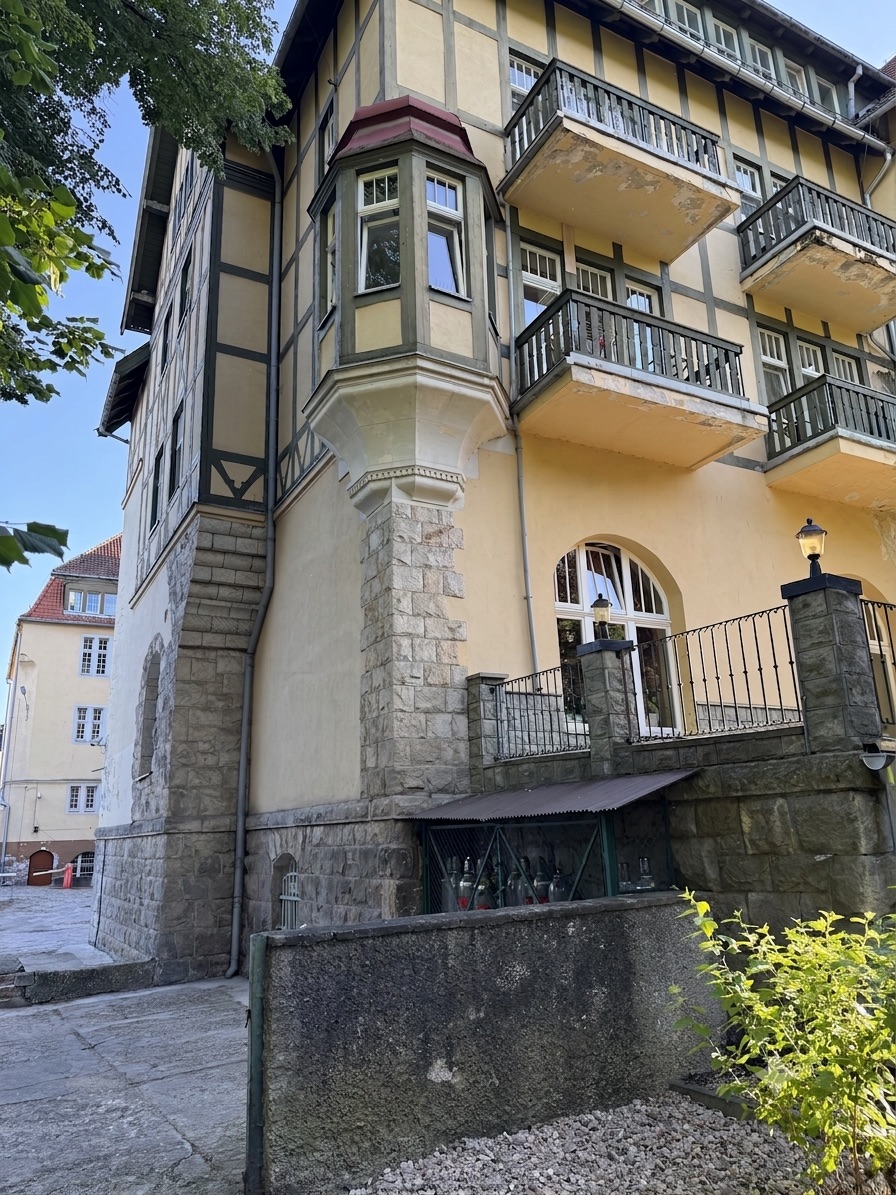
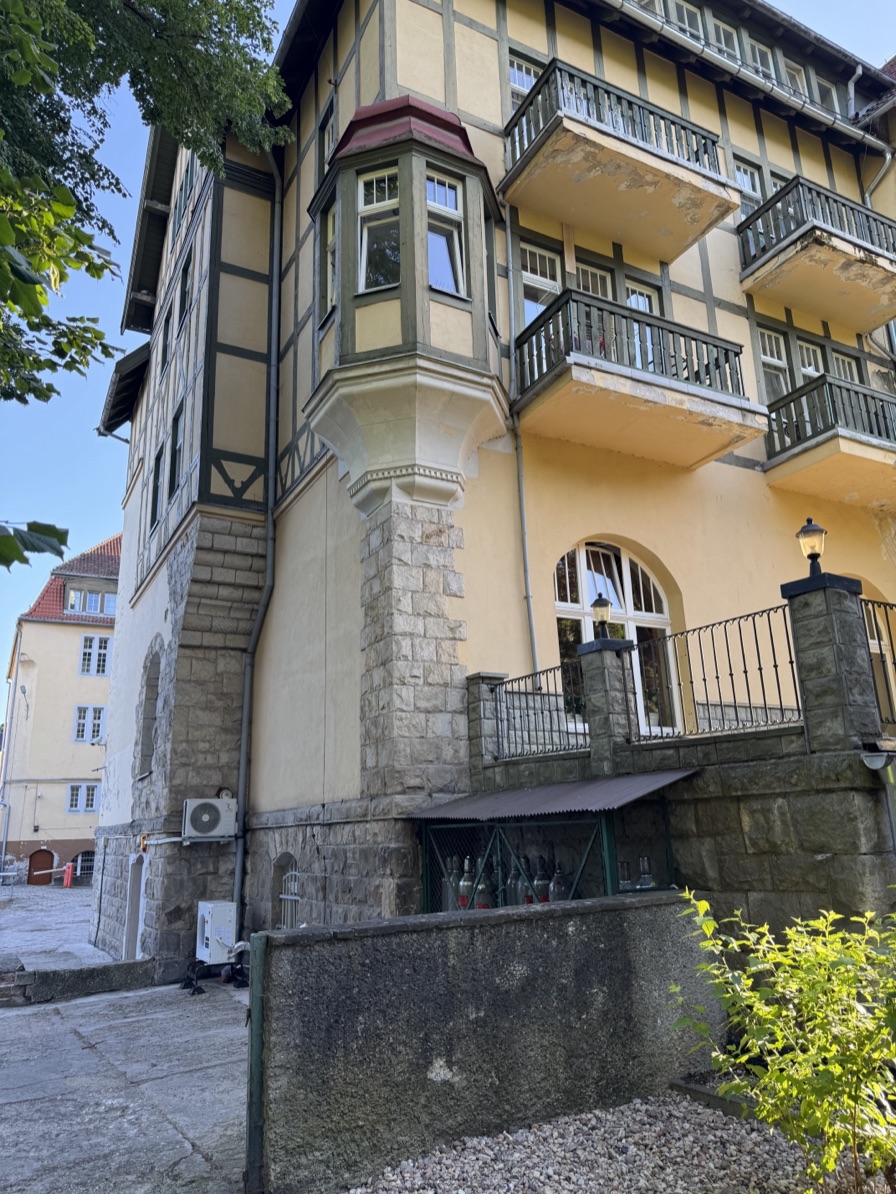 without AC with AC
 Kudowa-Zdrój, Poland. AC unit removed with AI for comparison.
Add the physics: outdoor coils frost up precisely in NW-European winter weather, and defrost cycles tax efficiency hardest in humid-mild climates. The lesson isn’t that neighbours and heritage boards are wrong. It’s that the outdoor box is the product’s weakness, not the heat pump idea itself.
Go underground
Right under that contested facade lies the answer. A few metres down sits a source of constant temperature: Central European ground holds a steady 9–11°C all year, warmer than winter air and cooler than summer air. A ground-source heat pump taps it through a borehole and simply doesn’t care about the weather.
This is measured, not theoretical. Fraunhofer ISE monitored heat pumps in 56 existing buildings, built 1850–2001, mostly on ordinary radiators: ground-source delivered a seasonal efficiency of 4.1 versus 3.1 for air-source, a third better, with the biggest gap on the coldest days. The unit sits indoors, fridge-sized and fridge-quiet: no facade box, no defrost, no night-time hum. England’s planning law says it plainly: ground-source heat pumps get permitted development with zero conditions, while air-source carries a page of them. In summer, the same borehole gives nearly free cooling. Circulate brine and the running cost is around £20 a year. And it lasts: ~25 years for the unit, 50+ for the loop.
Sweden proves it scales: more than half a million systems, one in five single-family houses.
Shrink the drill
So why is the best technology only ~4% of European heat pump sales, and shrinking? One word: drilling. A ground-source install costs about twice an air-source one, and the borehole is most of the difference: €50–100 per metre in Germany, €8–15k per home all-in. Sweden, with a mature drilling industry, pays ~€20 per metre. The gap is not physics; it’s industry structure.
Worse, the rig often can’t even reach the garden. A typical setup is an 8-tonne tracked rig plus a 3.5-tonne compressor with a mast several metres tall. The machine alone is wider than most European garden gates. The evidence that this is the bottleneck: America’s best-funded residential geothermal startup, Dandelion Energy, pivoted from retrofits to new-build subdivisions because batch-drilling empty lots is the only way its economics work. SLB’s Celsius Energy won’t take residential jobs below 50 kW. In Europe, where renovation is five times the market of new construction and clients value longevity (brick houses, not wood frames), this is precisely the point: a 50-year ground loop belongs in a house built to last a century.
Cost curves, not mandates
How do transitions actually happen? Solar fell ~90% in a decade. Batteries went from over $1,200 to $115 per kWh. In 2024, two-thirds of EVs sold in China were cheaper than their petrol equivalents before subsidies, and adoption followed the price, not the decree.
Now the counter-example. Germany’s 2023 boiler-ban law triggered a political firestorm that pollsters called a main driver of the AfD’s surge to 22%, and when subsidies wobbled, European heat pump sales fell 21% in a year, 48% in Germany. A product whose demand halves when a subsidy is renegotiated is not yet winning on economics. Compare the incandescent-bulb phase-out, which caused no backlash because LED prices had already fallen ~90%. The ban merely ratified a decision the market had made.
There is a quieter distortion here, and fixing it costs nothing: today’s price signal is rigged against the electric option. Power generation pays the EU’s carbon price on every kilowatt-hour; the gas burned in home boilers mostly does not, and the EU-wide scheme that would change that, ETS2, has been pushed back to 2028. A heat pump wins on running cost when electricity is at most about double the price of gas; the actual ratio is about 3.3 in Germany and over 4 in the UK. The Netherlands shows what repairing the signal does: it shifted levies from electricity onto gas, and heat pump sales jumped 53% in a single year. Before Europe writes another subsidy cheque, it could simply stop taxing the clean option harder than the fossil one.
Export cool to the world
Whoever cracks cheap boreholes doesn’t just fix Europe. Cooling is the fastest-growing energy use in buildings on Earth, already ~10% of global electricity. China runs the world’s largest ground-source base: 841 million square metres of heated and cooled floor space, including Beijing’s Daxing airport. US utilities are becoming drilling customers: the first utility-owned geothermal network went live in Massachusetts in 2024, and New York legally requires its utilities to pilot thermal networks. The physics travels to hot climates too: a Riyadh modelling study found ground-source cooling uses 36% less energy than air-source AC.
And the same compact rig drills water wells: 2.2 billion people still lack safely managed drinking water, and the sector’s own guidance calls for “smaller and less costly rigs”. Europe still exports ~€200 billion of machinery a year. Draghi’s report concedes solar is entirely lost to China and says to double down on advanced manufacturing.
Instead of playing a loser’s game of catch-up in markets whose window may have already closed, it is time to innovate and lead in a new one.
The McDonald’s of boreholes
There is a business model hiding in all of this. Drilling is a fragmented local trade: thousands of small firms, each with its own rigs, its own habits, its own prices. Fast food looked exactly like this in the 1950s, and the fix was not just a better burger. It was a system: one standard kitchen, one training programme, one brand, and financing for the operator. McDonald’s sold the system and let thousands of local owners sell the burgers.
Run the same play with a compact rig. The franchisor standardizes the machine, the drilling protocol, the certification, the borehole-planning software, and the financing. The franchisee is the local plumber or electrician who already installs heat pumps and already owns the customer relationship; drilling becomes one more day in their calendar instead of a subcontracted mystery. Every hole feeds data back to the centre, so the ten-thousandth borehole is drilled faster and cheaper than the first. That learning loop is what took solar down its cost curve, and it is how drilling gets from German prices to Swedish prices everywhere.
The prize scales like fast food, not like mining: a borehole shop in every town, in fifty countries, on one brand and one playbook. That is a billion-euro company, and nobody has built it yet.
Give a non-AI startup a shot
In 2025, AI captured roughly half of all venture capital on the planet, over 60% of US dollars. Everything physical is starved: early-stage climate hardware funding keeps shrinking, and 69% of investors expect first-of-a-kind hardware funding to get worse. I think this is exactly backwards, and I put my money where my mouth is.
Disclosure: I am an angel investor in FlexDrill, a Vienna startup building the missing machine from this article. Its founder, Sævar Örn Einarsson, is an Icelandic engineer who grew up on drilling. The company tells the story of his grandfather, who headed Iceland’s State Drilling Company during the years Iceland drilled its way to geothermal independence. Iceland’s famous Blue Lagoon is one fruit of that labour. His observation: “50 years later we still use the same principles to drill, but better methods have been developed in other fields.”
FlexDrill’s rig is designed around one number: a 1 m² footprint. Instead of a heavy rig hammering from the surface through rigid rods, it sends high-pressure water down a flexible hose to a hammer at the bit, so the machine on top can be small enough to roll through a doorway, into a courtyard, even down to a basement. It targets 200-metre boreholes, single-day drilling, and a 60–70% cut in drilling cost. The first deployment is planned for this summer in an architecture office in Vienna’s 16th district. Hardware is hard, but this is the right bet for the future.
Thank you for reading. Of course, this doesn’t exhaust the subject: interconnectors, batteries, nuclear, tariff reform, driller training, faster permits. People smarter than me have written those plans, and yes, Europe should do them. In December 1861, someone lit the first gas lamp in Bielitz, and it took a century to put the last one out. This time Europe doesn’t have a century, but it also doesn’t need one: the better technology is already under our feet. Someone will drill the first one-square-metre borehole in a Vienna courtyard this year. Europe shouldn’t wait for the weather to be merciful. It’s time to make Europe cool again.